.svg)
If you've spent any time shopping around for a new business website, you've probably noticed the prices are all over the shop.
One freelancer says they’ll do it for £300. An agency quotes £15,000.
Upwork shows someone in another timezone willing to do it for £150.
Your mate’s cousin says he can “knock one up” for a crate of beer.
And none of them seem to explain the difference in a way that makes sense.
Agencies throw around a lot of buzzwords and jargon to justify the huge price tags, and typically try to bolt on as many ongoing fees as they can.
If you ask a budget freelance designer about SEO, they’ll think you mean a WordPress plug-in called “Yoast” — and that’s where their understanding ends.
So how much should it cost?
Well, how long's a piece of string?
A website isn’t a commodity. It’s not bread. It’s not petrol. It’s not something with a fixed, universal price tag.
It’s closer to hiring someone to build you a new extension on your house — the quote depends entirely on who’s doing the work, how they do it, and whether it actually stands up after the paint dries.
So that's why I wrote this guide: to help you understand what you should be paying for your business website.
No bullshit, no jargon, no secret herbs and spices — just a clear, honest breakdown of what a real, revenue-producing website costs in 2025… and why.
By the time you've finished this article, you’ll know:
- What different types of providers actually charge (UK freelancer, expensive agency, offshore, etc.)
- What you’re actually paying for at each level
- What’s a red flag
- What’s fair
- And what a good, strategic, conversion-driven website should realistically cost a UK service business this year
Let’s get into it.
What you’re really buying when you buy a website
There are a few reasons you might want a new website — maybe you're just launching a new business, or you’re doing a bit of a “brand refresh”. Maybe your business has been running for years without one, and people around you keep telling you that you need to get with the times. You might have had a few prospects get in touch and comment that your existing website is hard to navigate, outdated or non-existent.
A lot of the time though, businesses need a new website to do a specific job: help get more customers.
So it stands to reason that you're not buying pages, a "nice design" and button hover animations — you're buying a solution to that problem.
You're actually buying a digital salesperson.

A good website doesn’t just decorate your business or list your phone numbers online.
It drives enquiries, filters time-wasters, increases trust, and makes you look like the competent, reliable, “we know what we’re doing” option.
The difference between a £500 site and a £5,000 site is the difference between:
A jack-of-all tradesman who slaps your house's extension together and ducks your calls 6 months later when the foundations start to crack
versus
The competent, professional construction firm whose bricklayers, joiners, carpenters and electricians turn up on time, do the job right and make sure you're getting your money's worth.
When you understand this, the price ranges start to make sense.
Price tier breakdown (2025 UK)
This is the bit everyone skips straight to, so let’s get right to it.
Below are the typical website provider tiers in the UK, what they cost, and what you actually get for the money.
1. The Offshore Bargain Bin (£50–£300)
Pay peanuts, get monkeys — think: Upwork, Fiverr, overseas outsourcing, “my nephew is learning coding”, etc.
This'll get you a basic template with zero strategy, research or content. This person probably doesn't understand UK markets and may also be reselling the same site over and over again to others in your industry.
Also — can you handle constant communication issues, huge time differences and ghosting once you've paid?
This isn’t their fault — you’re paying for basic labour, not expertise.
This might work for people who don’t need results, don’t care about their online presence/brand and don’t mind rebuilding the entire site in 6 months.
Ballpark: £50–£300
Cheap because: no strategy, no copywriting, no brand development, no UX, no testing, no thought… just pixels on a page.
2. The Cheap UK Freelancer (£500–£1,000)
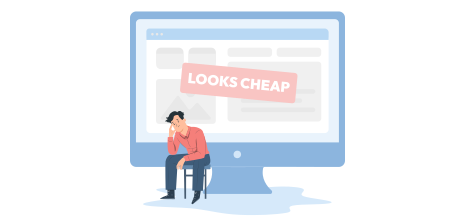
A common scenario when looking for a website provider, is that a business will settle on an inexpensive '"one-man-band" who does everything — planning, designing and building.
You’ve probably seen these ads on Facebook groups:
“I’ll build your full business website for £500 — unlimited pages!”
This tier is usually comprised of students, hobbyists and WordPress template flippers. You're not getting a unique website in this price range, and it'll probably be slapped together with flaky plugins because the freelancer doesn't know that a few lines of simple code could achieve the same thing without the ongoing headaches.
These are the people who think “SEO” means installing a plug-in.
Sure, you'll get a prettier site than you would with the ultra-budget tier — but it'll still be template-based, and often stitched together with plugins to make up for lack of expertise. You won't get any deep messaging or positioning, and virtually no strategy.
There won't be much time spent on understanding your customers or making the site's content speak to them, (in fact, it's more likely you'll need to provide your own content to the designer to just copy and paste into the template) so don't be surprised if your new site just sits there collecting dust, with nobody clicking.
Going forward, it's unlikely you'll have support or ongoing maintenance, so get used to making distressed calls that don't get answered when your website crashes.
So bottom line, your site might look nice, but it won’t necessarily work for what you need it for.
Ballpark: £500–£1,000
This tier is suitable for very low-budget micro-businesses, sole traders, tradesmen, side-hustlers, hobby projects, people with no brand or growth plan.
3. Smaller Agencies & Boutique Design Firms (£2,500 - £10,000)
This is the “Goldilocks zone” for most small-to-medium service businesses — and happens to be where we sit 😉
These are somewhere between a higher-end freelancer and a minimum-£25k-per-project agency polishing their awards shelf.
This tier is usually made up of companies with a small, highly skilled team. They'll be very hands-on, and focused on the foundations and getting results, not on fluff.
You should expect your project to include a comprehensive strategy suited to your business goals and preferred customers, professional copywriting, custom design and development and an ongoing package that includes maintenance and support, and maybe even some regular optimisations for visibility and usability.
This is the perfect tier for most small-to-medium service businesses in the UK — you'll get the best of both worlds: something that feels like agency quality without agency-level overheads.
Ballpark: £2,500–£10,000 upfront
- £150–£250/month ongoing for hosting, maintenance and support (and maybe edits)
- Additional £X hundreds per month for ongoing SEO and data-driven improvements.
This is where companies get sites that perform without needing to remortgage the house.
4. The Mid-Tier UK Agency (£8,000–£25,000)
This is where things start getting expensive...
These types of firms usually include massive teams of project managers, designers, developers, strategists, copywriters and QA testers.
What you get
Workshops, brand alignment, thorough UX/UI, market research, full SEO and ad campaigns — and a ton more that sounds impressive in a slide deck.
This is of course where you'd expect the biggest and best results to justify the huge price tag.
You’re paying for a team, not a person.
The catch
Bigger teams = much higher overhead.
More overhead = higher quotes.
And after all that, the website still might not deliver anything meaningful.
Agencies at this size often chase vanity metrics — “Look, your traffic doubled!” — while ignoring what actually matters: enquiries, revenue, conversion rate, and the quality of leads. Some also outsource their SEO to cheap bulk providers, which leads to all the classic nonsense Google hates: keyword-stuffed articles, irrelevant paid backlinks, and generic content pumped out just to hit a quota.
Ballpark: £8,000–£20,000
(This is also where a lot of agencies overcharge for the basics because clients don’t know the difference.)
5. The big guys (£20,000–£150,000+)

It's unlikely you'd need this tier if you're reading this article. This is where massive corporations, governments and huge multi-national brands are serviced.
They often include legal teams, huge design and dev teams and dedicated QA. Each step in the process might have half a dozen specialists working on it — and you pay for every single cog in that machine.
Coca Cola's designers might have spent a week on the button colours here, a month on the headline there. You don't need that time (and cost).
Ballpark: £20k–£150k+
Not relevant for 99.9% of UK service-based businesses.
What actually affects the price
A website isn't just a pretty picture. It's a combination of several skillsets.
If one or more of these skillsets is missing, the site will look fine but perform terribly.
Here's all the pieces of the puzzle required for your website project to be successful:
Strategy & discovery
Simply put, this just means: understanding your business goals, who your customers are and what you want them to do when they visit your site.
Think of it like the architect for your house extension project. This is where your business goals are assessed, and a thorough plan is mapped out to ensure your website's visitors get what they came for, and that they're guided naturally towards the action you want them to take. Before anyone swings a hammer, they need to know where to swing it and why.
This stage requires your provider to understand buyer psychology, recognise where your business sits in the market, and map out the structure and journey that moves visitors from curious to ready to get in touch.
Without this stage, everything else is guesswork.
Copywriting
Probably the most underrated and overlooked part of a website.
Your homepage hero might be a beautiful shade of chartreuse and your button hover animations might be crisp and bouncy — but your copy (written content) is what sells. Design just makes it easier to read.
Think about it — when you visit a service business's website yourself, it's mainly to read about their business and what they can do for you. When was the last time you chose a plumber because their website's footer had a nice font?
High-quality, SEO-friendly, conversion-focused copy can make or break a website project. It can help you get found on Google, and convince your visitor to pick you over the rest.
Custom design
This one trips a lot of people up, because they think "we don't need anything custom — a template will do us".
That's a mistake.
A template is a pre-built website where someone swaps the colours, drops in your logo, pastes your content, and calls it a day.
No planning.
No visual hierarchy shaped around your goals.
No differentiation.
A few hours of light admin and boom: here’s your “new” site — which just so happens to look almost identical to 200 other businesses, including ones nowhere near your industry.
A custom-designed website takes the baton from the strategy phase of your project. This ensures every layout, every section, every piece of content, and every interaction actually serves the message and user journey you’ve mapped out.
It doesn’t mean you need some wild artistic masterpiece.
It just means you want something that’s yours — aligned with your brand, consistent with your messaging, and built by someone with the skill to communicate all of that through visual design.
Development
This is a confusing one for a lot of people — mainly because "development" can mean a lot of different things to different people.
To a basic freelance designer, it might mean a Wix or Squarespace template, or another drag-and-drop page builder that makes "development" easy for non-techy people.
To a seasoned software engineer, it might mean a ton of custom-coded bells and whistles that are more about flexing coding skills than achieving a purpose.
Simply put, development is the stage of a project where everything you've done thus far is translated into code that a browser can see and interact with.
A lot of one-man-band designers will "develop" a site using stitched-together WordPress plugins and a WYSIWYG editor because they lack the skill to actually code a full website themselves — and this leads to countless problems down the line with compatibility, mobile responsiveness, browser updates and maintenance (which translates to downtime for your business's best digital sales tool).
You're much better having your site built using the basic language of the web: simple HTML and CSS (with a little bit of JavaScript). To do this, your provider needs a real developer on the team, not someone who did a 4-hour course on WordPress and doesn’t know their <a> tag from null.
SEO foundations
You don’t need a full SEO team chasing backlinks, writing press releases, and trying to get you featured in the Financial Times. But you do need someone who understands the SEO essentials — and here’s the catch:
If you ask a developer about SEO, they’ll talk about structure, URLs, schema, metadata, speed, crawlability, and accessibility. And they’re not wrong — any competent developer should be ticking all of that off by default.
If you ask a content writer about SEO, they’ll tell you your pages need to be written with intent, using language your target audience actually types into Google.
And that’s the point:
SEO isn’t one thing. It’s a blend of multiple disciplines working together.
Technical foundations, content strategy, and user intent all have to align — otherwise the site looks great, loads fast, and ranks for… absolutely nothing useful.
Analytics & improvements
You need to know whether your assumptions about your market, customers, and positioning are actually correct — and whether the site is doing the job you built it to do.
For that, you need analytics.
Not the “ooh, look, 300 people visited your site this week” kind…
but the stuff that actually tells you what’s working and what’s quietly sabotaging your conversions.
Without data telling you which pages people spend time on, how far they scroll, where they drop off and what they click (and don't click), you’re flying blind.
Guessing is how businesses end up redesigning perfectly good pages, obsessing over pointless metrics, or spending money in places that never produce a single enquiry.
The goal isn’t to drown in numbers — it’s to get a clear, honest picture of how real humans behave on your site. Once you have that, you can make small, targeted improvements that actually move the needle instead of blindly throwing changes at the wall.
Analytics isn’t about vanity.
It’s about clarity: what’s working, what isn’t, and what to fix next.
Maintenance
No site is “set and forget.”
Everything needs updates, backups, monitoring, and ongoing tweaks.
You wouldn't buy a car then never get it serviced.
Support & communication
Often overlooked…
but if your provider disappears, you’re stuck.
Overseas freelancers, Fiverr/Upwork devs and one-man-bands typically take ages to respond (or ghost you completely), and your bigger agencies fob you off to outsourced support queues.
You want a close partner who cares about your business and about getting you the results you're paying for (and actually picks up the phone).
The real cost of going too cheap
You can absolutely get a cheap website.
You just can’t get a cheap website that works.
Problems with cheap builds often don't even show up 6–12 months later. Problems like ranking on page 350 of Google, broken updates/plugins, slow load times, a clunky CMS and no ongoing support.
Most businesses who go cheap end up paying twice — once for the cheap site, and then again when they realise it doesn’t work and they have to rebuild it properly.
The real cost of a website isn’t the invoice — it’s the 12 months of lost opportunities and pulled-out hair.
What a professional website SHOULD include in 2025
A proper, results-focused website for a UK service business should include:
Essential
- Strategy (even a basic blueprint is better than swinging the hammer without a guide)
- Brand/message refinement
- Professionally written content
- Custom design and a clean, professional and mobile-optimised build
- Fast hosting
- CMS setup (or edits worked into your maintenance plan)
- On-page & technical SEO
- High-quality visuals
- Speed and accessibility optimisation
If your quote doesn’t include most of that, it’s not a professional website — it’s decoration. Take a look at our article here to learn more about what your website package should include.
So… what should YOU expect to pay?
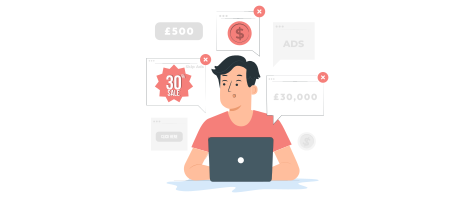
If you're a UK service-based business (trades, professional services, commercial contractors, consultants, hospitality providers, etc.), here's what you should expect to pay for a credible, professional, lead-generating website:
£2,500–£10,000 upfront for a simple 5-10 page website.
If you want e-commerce functionality, tack on another few thousand to that. You're looking at minimum £5,000-7,000 but probably north of £10k even for a small e-comm brand.
- £150–£250/month ongoing minimum for hosting, maintenance and support.
Expect to pay a few hundred more per month for data-driven improvements and optimisations.
This gets you:
- Clear messaging
- Copy that actually persuades
- Strategy
- A proper CMS
- Custom design
- SEO foundations
- Analytics
- Maintenance
- A partner you can email without waiting a week
Anything significantly cheaper misses something essential.
Anything much more expensive is usually overkill.
How to quickly spot a rip-off (on both ends of the spectrum)
If it’s TOO cheap
Red flags:
- No copywriting/"provide your own content"
- “Unlimited pages”
- £500 for a full brand + site
- No process
- No discovery
- No support
- Under a week turnaround
- Dodgy contract (or no contract)
- Template look
- A "developer" using Wix or Squarespace
- Foreign hosting
- No maintenance plan
If it’s TOO expensive
- £20k+ for a simple 5–7 page brochure site for your small-to-medium service business
- Charging hourly for everything
- Charging extra for obvious essentials (mobile responsiveness, meta titles and descriptions, contact forms)
- Paying for teams you don’t benefit from
- You're passed around from team member to team member and nobody takes accountability.
You want the sweet spot:
A small, skilled team with low overheads but high standards.
The takeaway
In 2025, for a UK service business, a proper professional website isn’t a £500 impulse buy, and it’s not a £25k luxury splurge.
It’s a £2.5k–£10k strategic business asset that drives enquiries, supports sales, and actually pays for itself.
This is what we do.
If you want a site that genuinely improves your business — not just something that fills a URL — get in touch.
We’ll build something that works, not something that just sits there.